|
| subroutine, public | crystal_router_pack (out, dest, body) |
| | Append one record to a packed crystal-router buffer.
|
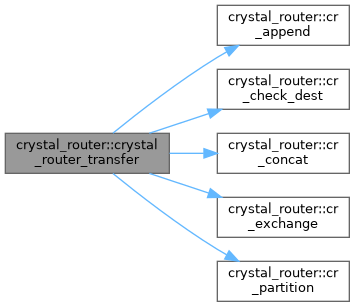
| subroutine, public | crystal_router_transfer (buf, n) |
| | Route packed records to their destination ranks.
|
| subroutine | cr_check_dest (buf, n) |
| | Abort if any record destination falls outside \( [0, P) \).
|
| subroutine | cr_partition (buf, n, mid, lower, keep, nkeep, snd, nsnd) |
| | Partition buf into records kept locally and records to be sent. A record is kept when the side of its destination (relative to mid) matches lower, i.e. it already belongs to our half.
|
| subroutine | cr_exchange (sbuf, sn, dst, rbuf, rn, src) |
| | Size-negotiated bidirectional exchange with a partner. Either dst or src may be MPI_PROC_NULL to make that direction a no-op.
|
| subroutine | cr_concat (buf, n, a, na, b, nb) |
| | Rebuild buf as the concatenation a(1:na) ++ b(1:nb).
|
| subroutine | cr_append (buf, n, e, ne) |
| | Append e(1:ne) to buf(1:n) in place.
|
Routes a set of variable-length records, each tagged with a destination rank, from any source to any destination in \( \lceil \log_2 P \rceil \) communication stages. This replaces dense \( O(P) \)-round neighbour discovery / personalized exchange (which is \( O(P^2) \) globally and, under flat MPI at high rank counts, exhausts the MPI runtime's internal unexpected-message buffers) with a recursive-bisection routing that talks to at most one or two partners per stage.
The algorithm is the crystal router of Fox et al., "Solving Problems on
Concurrent Processors, Volume 1", Prentice-Hall, 1988.
Records are passed in a single packed integer(i8) buffer as a sequence of self-describing entries
!!     [ dest, len, payload(1), ..., payload(len) ]
!!
where dest is the destination rank in \( [0, P) \) and len is the payload length. On return the buffer holds exactly the records whose dest equals pe_rank, in the same packed format (the dest/len headers are preserved so the caller can unpack uniformly).
Algorithm and correctness
The active rank range [lo, hi) always contains pe_rank; it starts as [0, P) and is halved each stage at mid = lo + (hi-lo)/2. A record is kept if its destination lies in the local half and otherwise shipped to a partner in the opposite half. Since a record is always moved into the half containing its destination, the range invariant "`dest in [lo, hi)`" is preserved, and when the range collapses to a single rank that rank is the destination – so every record is delivered exactly once and none is dropped.
For odd-sized ranges the upper half has exactly one more rank than the lower half, leaving one unpaired upper rank (hi-1). That rank still holds records destined for the lower half; it offloads them to rank lo, which performs one extra receive. All other ranks exchange with a single partner via MPI_Sendrecv, and the unpaired transfers use MPI_PROC_NULL for the idle direction, so every stage is fully matched and deadlock-free for any P (not only powers of two). Message sizes are negotiated per stage (a one-integer count exchange precedes each data exchange), so no global maximum buffer is ever allocated.