
von Kármán turbulent boundary layer
Extreme-scale direct numerical simulation of the von Kármán turbulent boundary layer induced by a rotating disk with 18 billion GLL points, reaching a friction Reynolds number of 2300.
The Neko development team is pleased to announce the release of Neko v1.1, released during WCCM-ECCOMAS 2026 in Munich.
17 Jul 2026 Neko's compressible solver runs across 1.77 million cores of FugakuNeko’s new compressible flow solver has been exercised on up to 1,769,472 CPU cores of the supercomputer Fugaku at RIKEN R-CCS in Kobe, Japan — 36,...
14 Jul 2026 Neko at WCCM-ECCOMAS 2026We are pleased to announce that Neko will be well-represented at WCCM-ECCOMAS 2026. Members of our community and the core development team will be ...
Extreme-scale direct numerical simulation of the von Kármán turbulent boundary layer induced by a rotating disk with 18 billion GLL points, reaching a friction Reynolds number of 2300.
A canonical flat-plate turbulent boundary layer visualization, showing the developing vortical structures.
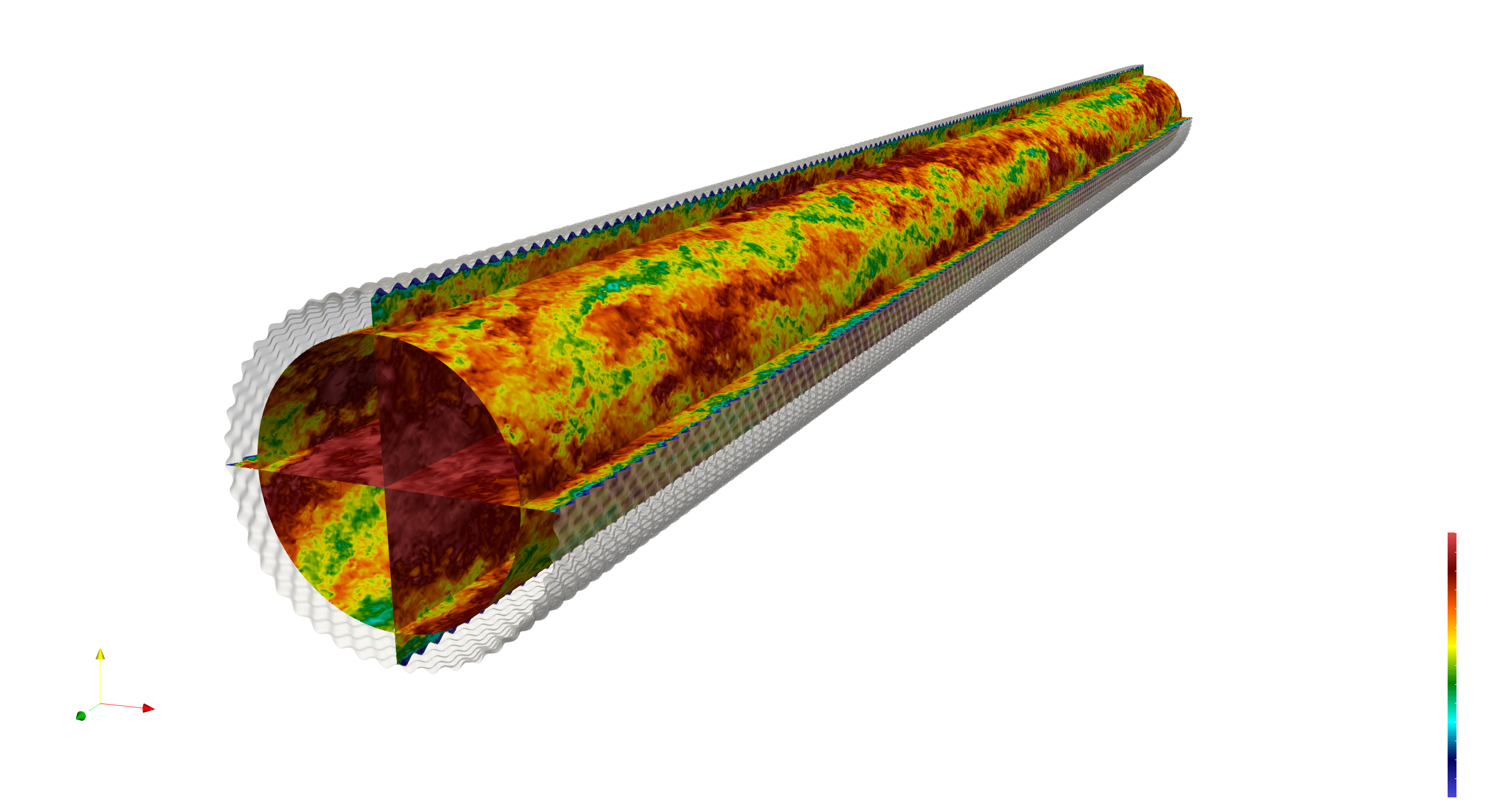
Rough-pipe flow at friction Reynolds number 2000. The image shows slices of streamwise velocity.
A simulation of the Flettner rotor, a device that leverages the Magnus effect to generate propulsion.
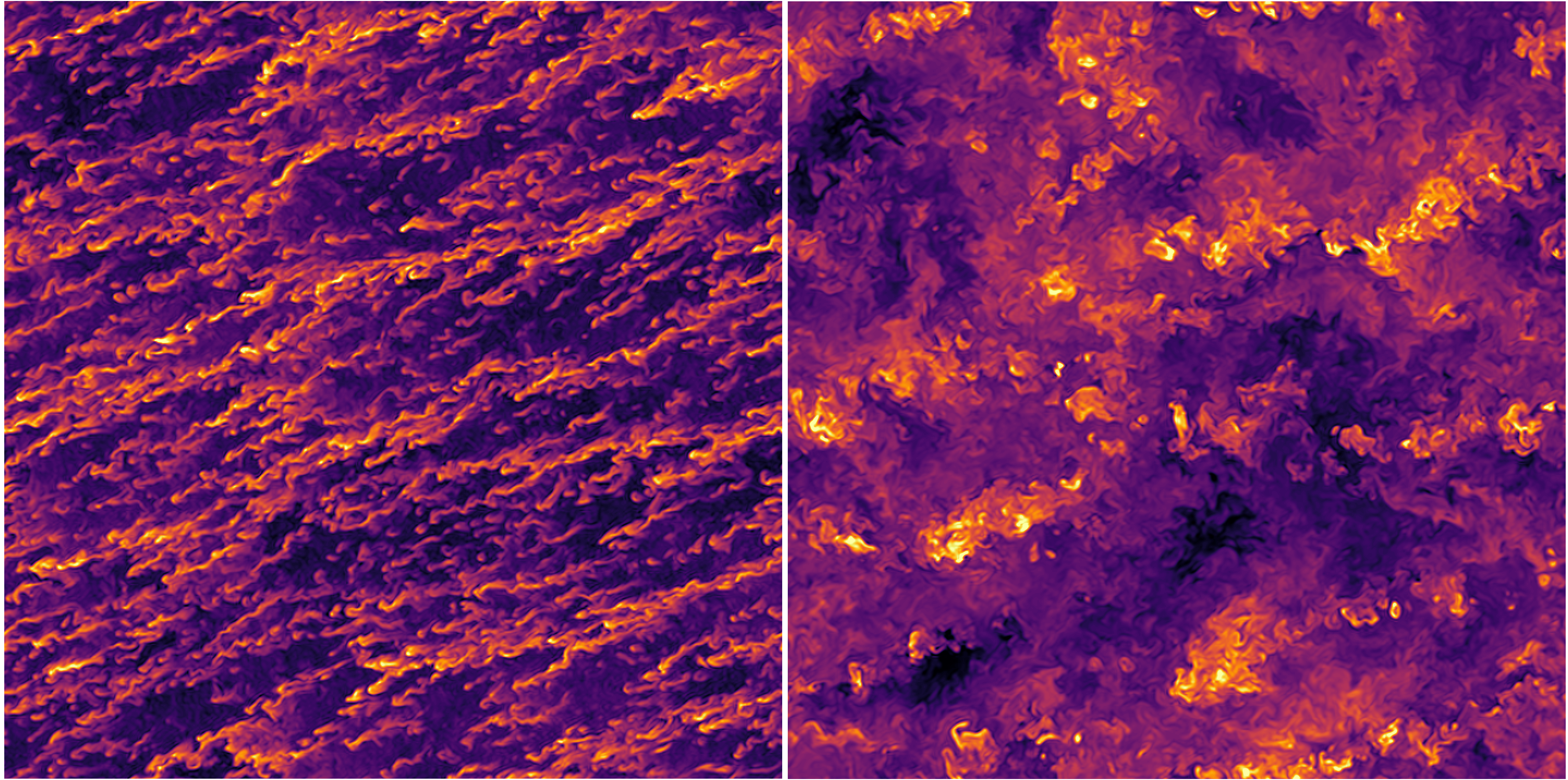
Slices showing coherent temperature structures in a shear-convective atmospheric boundary layer. A large-eddy simulation with the buoyancy-corrected Vreman model.
2026
“Assessment of the gradient jump penalisation in large-eddy simulations of turbulence.” Acta Mechanica. DOI.
2026
“A Matrix-Free Algebraic hp-Multigrid Method for Computational Fluid Dynamics Applications.” Proceedings of the Supercomputing Asia and International Conference on High Performance Computing in Asia Pacific Region (SCA/HPCAsia '26). DOI.
2026
“Influence of turbulence inflow conditions on aeroacoustics of wall-bounded flows.” International Journal of Heat and Fluid Flow, 118, 110216. DOI.
2025
“Investigation of the Dynamics of Secondary Flow Vortex Systems in Low-Pressure Turbines Using Direct Numerical Simulation.” Proceedings of the ASME Turbo Expo 2025: Turbomachinery Technical Conference and Exposition. Volume 12. Memphis, Tennessee, USA. June 16-20, 2025. V012T36A005. ASME. DOI.
The development of Neko was supported by the European Commission Horizon 2020 project grant EPiGRAM-HS: Exascale Programming Models for Heterogeneous Systems (grant reference 801039), the European High Performance Computing Joint Undertaking (JU) and Sweden, Germany, Spain, Greece and Denmark under grant "CEEC - Centre of Excellence for Exascale CFD" (grant agreement No 101093393), the Swedish Research Council project grant Efficient Algorithms for Exascale Computational Fluid Dynamics (grant reference 2019-04723) and the SeRC Exascale Simulation Software Initiative (SESSI).
The Neko logo was designed by Robert Hansen Jagrelius.
 Sponsored by Zulip
, an open-source modern team chat app designed to keep both live and asynchronous conversations organized.
Sponsored by Zulip
, an open-source modern team chat app designed to keep both live and asynchronous conversations organized.