Gather-scatter communication using an MPI neighbourhood collective. The whole halo exchange is carried out by a single MPI_Ineighbor_alltoallv over a distributed-graph communicator built once from the send/recv peer lists. Compared to the point-to-point gs_mpi_t this trades N Isend/Irecv pairs for one collective call: a single entry into the (serialised, on Fugaku) MPI runtime, leaving the library free to stripe the transfers across all network interfaces internally.
More...
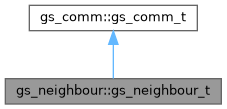
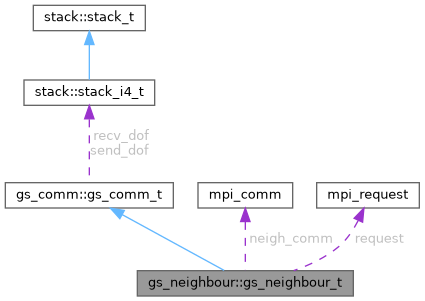
Public Member Functions | |
| procedure, pass(this) | init (this, send_pe, recv_pe) |
| Initialise the neighbourhood-collective communication method See gs_comm.f90 for details. | |
| procedure, pass(this) | free (this) |
| Deallocate the neighbourhood-collective communication method. | |
| procedure, pass(this) | nbsend (this, u, n, tag, deps, strm) |
| See gs_comm.f90 for more details on these routines. | |
| procedure, pass(this) | nbrecv (this, tag) |
| No-op: the neighbourhood collective issued in nbsend handles both the send and receive directions, so there is nothing to pre-post here. | |
| procedure, pass(this) | nbwait (this, u, n, op, strm) |
| Wait for the neighbourhood collective and reduce the received slabs. | |
| procedure, pass(this) | init_vec (this) |
| Allocate the fused vector exchange buffers and the nc-scaled collective descriptors, sized for GS_VEC_NC components. Deferred to the first fused exchange, see gs_comm_t. The graph communicator built in init is shared with the scalar exchange and is not touched here, so this stays rank local. | |
| procedure, pass(this) | nbsend_vec (this, u, n, nc, tag, deps, strm) |
| Pack the nc components and launch a single neighbourhood collective. | |
| procedure, pass(this) | nbrecv_vec (this, tag, nc) |
| No-op: the collective is launched in nbsend_vec. | |
| procedure, pass(this) | nbwait_vec (this, u, n, nc, op, strm) |
| Wait for the vector collective and reduce each received slab into u. Peer i's received slab holds nc consecutive blocks of recvcounts(i) values, matching the sender's packing convention. | |
| procedure(gs_comm_init), deferred, pass | init gs_comm_init |
| procedure(gs_comm_free), deferred, pass | free gs_comm_free |
| procedure(gs_nbsend), deferred, pass | nbsend gs_nbsend |
| procedure(gs_nbrecv), deferred, pass | nbrecv gs_nbrecv |
| procedure(gs_nbwait), deferred, pass | nbwait gs_nbwait |
| procedure, pass(this) | init_dofs (this) |
| procedure, pass(this) | free_dofs (this) |
| procedure, pass(this) | init_order (this, send_pe, recv_pe) |
| Obtains which ranks to send and receive data from. | |
| procedure, pass(this) | free_order (this) |
| procedure, pass(this) | take_schedule (this, src) |
| Take over the gather-scatter schedule (dof lists and peer order) of src, avoiding a second (expensive) pass over the connectivity. The data is moved rather than copied, so src is left without a schedule and must not be used for communication afterwards (it can still be freed). No communication resources are set up here; complete the handover with init_schedule once src has been freed, so that the two backends never hold their resources at the same time. | |
| procedure, pass(this) | init_schedule (this) |
| Set up this communication method for the schedule taken over by take_schedule. Collective, as init is. | |
| procedure, pass(this) | init_vec (this) |
| Fused vector halo exchange. Default implementations abort; backends that set vec_supported = .true. override them. | |
| procedure, pass(this) | nbsend_vec (this, u, n, nc, tag, deps, strm) |
| Default fused vector send. Abort unless a backend overrides it. | |
| procedure, pass(this) | nbrecv_vec (this, tag, nc) |
| Default fused vector receive. Abort unless a backend overrides it. | |
| procedure, pass(this) | nbwait_vec (this, u, n, nc, op, strm) |
| Default fused vector wait/reduce. Abort unless a backend overrides it. | |
Public Attributes | |
| real(kind=rp), dimension(:), allocatable | send_buf |
| Concatenated send slabs, one per peer, in send_pe order. | |
| real(kind=rp), dimension(:), allocatable | recv_buf |
| Concatenated recv slabs, one per peer, in recv_pe order. | |
| integer, dimension(:), allocatable | sendcounts |
| Per-peer counts and 0-based element displacements for the neighbourhood collective. send_* follow send_pe (the graph destinations), recv_* follow recv_pe (the graph sources). | |
| integer, dimension(:), allocatable | sdispls |
| integer, dimension(:), allocatable | recvcounts |
| integer, dimension(:), allocatable | rdispls |
| type(mpi_comm) | neigh_comm |
| Distributed-graph communicator over the halo neighbourhood. | |
| type(mpi_request) | request |
| In-flight non-blocking neighbourhood collective. | |
| real(kind=rp), dimension(:), allocatable | send_buf_v |
| Fused vector (multi-component) exchange buffers, sized for up to GS_VEC_NC components. Each peer slab holds nc consecutive component blocks. sendcounts_v/sdispls_v etc. are the nc-scaled collective descriptors, filled per call. | |
| real(kind=rp), dimension(:), allocatable | recv_buf_v |
| integer, dimension(:), allocatable | sendcounts_v |
| integer, dimension(:), allocatable | sdispls_v |
| integer, dimension(:), allocatable | recvcounts_v |
| integer, dimension(:), allocatable | rdispls_v |
| type(stack_i4_t), dimension(:), allocatable | send_dof |
| A list of stacks of dof indices local to this process to send to rank_i. | |
| type(stack_i4_t), dimension(:), allocatable | recv_dof |
| recv_dof(rank_i) is a stack of dof indices local to this process to receive from rank_i. size(recv_dof) == pe_size | |
| integer, dimension(:), allocatable | send_pe |
| Array of ranks that this process should send to. | |
| integer, dimension(:), allocatable | recv_pe |
| array of ranks that this process will receive messages from | |
| logical | vec_supported = .false. |
| Whether this backend implements the fused vector (multi-component) halo exchange (nbsend_vec/nbrecv_vec/nbwait_vec). When .false., the gs_op_r3 caller falls back to nc independent scalar exchanges. | |
| logical | vec_ready = .false. |
| Whether the buffers the fused vector exchange needs are in place. They are sized GS_VEC_NC times the halo, quadrupling what the backend holds, and only gs_op_r3 ever touches them, so a backend that can allocate them on its own defers that to the first fused exchange (see init_vec) rather than paying for it in every run. A backend whose vector buffers are part of an allocation the whole run has to agree on – symmetric memory, coarrays, registered memory, an RMA window – cannot defer, since a rank with no shared dofs never reaches the first fused exchange; those allocate in init and set this there. | |
Detailed Description
Definition at line 56 of file gs_neighbour.f90.
Member Function/Subroutine Documentation
◆ free() [1/2]
| procedure, pass(this) gs_neighbour::gs_neighbour_t::free | ( | class(gs_neighbour_t), intent(inout) | this | ) |
Definition at line 80 of file gs_neighbour.f90.
◆ free() [2/2]
Definition at line 82 of file gs_comm.f90.
◆ free_dofs()
|
inherited |
Definition at line 87 of file gs_comm.f90.
◆ free_order()
|
inherited |
Definition at line 89 of file gs_comm.f90.
◆ init() [1/2]
| procedure, pass(this) gs_neighbour::gs_neighbour_t::init | ( | class(gs_neighbour_t), intent(inout) | this, |
| type(stack_i4_t), intent(inout) | send_pe, | ||
| type(stack_i4_t), intent(inout) | recv_pe | ||
| ) |
Definition at line 79 of file gs_neighbour.f90.
◆ init() [2/2]
Definition at line 81 of file gs_comm.f90.
◆ init_dofs()
|
inherited |
Definition at line 86 of file gs_comm.f90.
◆ init_order()
|
inherited |
- Parameters
-
send_pe,only contains rank ids this porcesss should send to recv_pe,only the ranks this process should receive from
Definition at line 88 of file gs_comm.f90.
◆ init_schedule()
|
inherited |
Definition at line 91 of file gs_comm.f90.
◆ init_vec() [1/2]
|
inherited |
- Note
- Rank local by contract: a rank with no shared dofs skips the fused exchange entirely, so an override must not communicate.
Definition at line 94 of file gs_comm.f90.
◆ init_vec() [2/2]
| procedure, pass(this) gs_neighbour::gs_neighbour_t::init_vec | ( | class(gs_neighbour_t), intent(inout) | this | ) |
Definition at line 85 of file gs_neighbour.f90.
◆ nbrecv() [1/2]
| procedure, pass(this) gs_neighbour::gs_neighbour_t::nbrecv | ( | class(gs_neighbour_t), intent(inout) | this, |
| integer, intent(in) | tag | ||
| ) |
Definition at line 83 of file gs_neighbour.f90.
◆ nbrecv() [2/2]
Definition at line 84 of file gs_comm.f90.
◆ nbrecv_vec() [1/2]
|
inherited |
Definition at line 96 of file gs_comm.f90.
◆ nbrecv_vec() [2/2]
| procedure, pass(this) gs_neighbour::gs_neighbour_t::nbrecv_vec | ( | class(gs_neighbour_t), intent(inout) | this, |
| integer, intent(in) | tag, | ||
| integer, intent(in) | nc | ||
| ) |
Definition at line 87 of file gs_neighbour.f90.
◆ nbsend() [1/2]
| procedure, pass(this) gs_neighbour::gs_neighbour_t::nbsend | ( | class(gs_neighbour_t), intent(inout) | this, |
| real(kind=rp), dimension(n), intent(inout) | u, | ||
| integer, intent(in) | n, | ||
| integer, intent(in) | tag, | ||
| type(c_ptr), intent(inout) | deps, | ||
| type(c_ptr), intent(inout) | strm | ||
| ) |
Definition at line 82 of file gs_neighbour.f90.
◆ nbsend() [2/2]
Definition at line 83 of file gs_comm.f90.
◆ nbsend_vec() [1/2]
|
inherited |
- Parameters
-
u compact shared buffer, component-outer: u((c-1)*n + idx) n number of shared dofs (per component) nc number of components
Definition at line 95 of file gs_comm.f90.
◆ nbsend_vec() [2/2]
| procedure, pass(this) gs_neighbour::gs_neighbour_t::nbsend_vec | ( | class(gs_neighbour_t), intent(inout) | this, |
| real(kind=rp), dimension(nc*n), intent(inout) | u, | ||
| integer, intent(in) | n, | ||
| integer, intent(in) | nc, | ||
| integer, intent(in) | tag, | ||
| type(c_ptr), intent(inout) | deps, | ||
| type(c_ptr), intent(inout) | strm | ||
| ) |
- Parameters
-
u compact shared buffer, component-outer: u((c-1)*n + idx). Peer i's slab in send_buf_v holds nc consecutive blocks of sendcounts(i) values, so the collective descriptors are simply nc times the scalar ones.
Definition at line 86 of file gs_neighbour.f90.
◆ nbwait() [1/2]
| procedure, pass(this) gs_neighbour::gs_neighbour_t::nbwait | ( | class(gs_neighbour_t), intent(inout) | this, |
| real(kind=rp), dimension(n), intent(inout) | u, | ||
| integer, intent(in) | n, | ||
| integer | op, | ||
| type(c_ptr), intent(inout) | strm | ||
| ) |
Definition at line 84 of file gs_neighbour.f90.
◆ nbwait() [2/2]
Definition at line 85 of file gs_comm.f90.
◆ nbwait_vec() [1/2]
|
inherited |
Definition at line 97 of file gs_comm.f90.
◆ nbwait_vec() [2/2]
| procedure, pass(this) gs_neighbour::gs_neighbour_t::nbwait_vec | ( | class(gs_neighbour_t), intent(inout) | this, |
| real(kind=rp), dimension(nc*n), intent(inout) | u, | ||
| integer, intent(in) | n, | ||
| integer, intent(in) | nc, | ||
| integer | op, | ||
| type(c_ptr), intent(inout) | strm | ||
| ) |
Definition at line 88 of file gs_neighbour.f90.
◆ take_schedule()
|
inherited |
- Parameters
-
src the backend to take the schedule from, left without one
Definition at line 90 of file gs_comm.f90.
Member Data Documentation
◆ neigh_comm
| type(mpi_comm) gs_neighbour::gs_neighbour_t::neigh_comm |
Definition at line 67 of file gs_neighbour.f90.
◆ rdispls
| integer, dimension(:), allocatable gs_neighbour::gs_neighbour_t::rdispls |
Definition at line 65 of file gs_neighbour.f90.
◆ rdispls_v
| integer, dimension(:), allocatable gs_neighbour::gs_neighbour_t::rdispls_v |
Definition at line 77 of file gs_neighbour.f90.
◆ recv_buf
| real(kind=rp), dimension(:), allocatable gs_neighbour::gs_neighbour_t::recv_buf |
Definition at line 60 of file gs_neighbour.f90.
◆ recv_buf_v
| real(kind=rp), dimension(:), allocatable gs_neighbour::gs_neighbour_t::recv_buf_v |
Definition at line 75 of file gs_neighbour.f90.
◆ recv_dof
|
inherited |
Definition at line 58 of file gs_comm.f90.
◆ recv_pe
|
inherited |
Definition at line 64 of file gs_comm.f90.
◆ recvcounts
| integer, dimension(:), allocatable gs_neighbour::gs_neighbour_t::recvcounts |
Definition at line 65 of file gs_neighbour.f90.
◆ recvcounts_v
| integer, dimension(:), allocatable gs_neighbour::gs_neighbour_t::recvcounts_v |
Definition at line 77 of file gs_neighbour.f90.
◆ request
| type(mpi_request) gs_neighbour::gs_neighbour_t::request |
Definition at line 69 of file gs_neighbour.f90.
◆ sdispls
| integer, dimension(:), allocatable gs_neighbour::gs_neighbour_t::sdispls |
Definition at line 64 of file gs_neighbour.f90.
◆ sdispls_v
| integer, dimension(:), allocatable gs_neighbour::gs_neighbour_t::sdispls_v |
Definition at line 76 of file gs_neighbour.f90.
◆ send_buf
| real(kind=rp), dimension(:), allocatable gs_neighbour::gs_neighbour_t::send_buf |
Definition at line 58 of file gs_neighbour.f90.
◆ send_buf_v
| real(kind=rp), dimension(:), allocatable gs_neighbour::gs_neighbour_t::send_buf_v |
Definition at line 74 of file gs_neighbour.f90.
◆ send_dof
|
inherited |
Definition at line 55 of file gs_comm.f90.
◆ send_pe
|
inherited |
- Note
- : this will usually be fewer than the total number of ranks size(send_pe) <= pe_size
Definition at line 62 of file gs_comm.f90.
◆ sendcounts
| integer, dimension(:), allocatable gs_neighbour::gs_neighbour_t::sendcounts |
Definition at line 64 of file gs_neighbour.f90.
◆ sendcounts_v
| integer, dimension(:), allocatable gs_neighbour::gs_neighbour_t::sendcounts_v |
Definition at line 76 of file gs_neighbour.f90.
◆ vec_ready
|
inherited |
Definition at line 79 of file gs_comm.f90.
◆ vec_supported
|
inherited |
Definition at line 68 of file gs_comm.f90.
The documentation for this type was generated from the following file:
- /home/runner/work/neko/neko/src/gs/gs_neighbour.f90