Scalar initial condition.
|
| subroutine | set_scalar_ic_int (s, coef, gs, type, params, i) |
| | Set scalar initial condition (builtin)
|
| |
| subroutine | set_scalar_ic_usr (scheme_name, s, coef, gs, user_proc) |
| | Set scalar intial condition (user defined)
|
| |
| subroutine | set_scalar_ic_common (s, coef, gs) |
| | Set scalar initial condition (common)
|
| |
| subroutine | set_scalar_ic_uniform (s, ic_value) |
| | Uniform initial condition.
|
| |
| subroutine | set_scalar_ic_expression (s, expr) |
| | Expression initial condition.
|
| |
| subroutine | set_scalar_ic_point_zone (s, base_value, zone_name, zone_value) |
| | Point zone initial condition.
|
| |
| subroutine | set_scalar_ic_fld (s, file_name, interpolate, mesh_file_name, i, target_idx, global_interp_subdict) |
| | Set the initial condition of the scalar based on a field. @detail The field is read from an fld file. If enabled, interpolation is also possible. In that case, the mesh coordinates can be read from another file in the fld field series.
|
| |
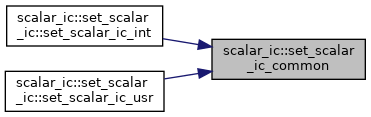
◆ set_scalar_ic_common()
Finalize scalar initial condition by distributing the initial condition across elements and multiplying by the coefficient (if any). Operates on the device array when running on GPUs, so the caller must make sure the values are there.
- Parameters
-
| s | Scalar field. |
| coef | Coefficient. |
| gs | Gather-Scatter object. |
Definition at line 199 of file scalar_ic.f90.
◆ set_scalar_ic_expression()
Set the scalar initial condition from a mathematical expression, evaluated in every GLL point of the mesh with x, y and z bound to the coordinates of the point. Constants declared under case.constants in the case file can be referred to by name, see the expression module for the full syntax.
- Parameters
-
| s | Scalar field. |
| expr | The expression prescribing the initial value. |
Definition at line 244 of file scalar_ic.f90.
◆ set_scalar_ic_fld()
| subroutine scalar_ic::set_scalar_ic_fld |
( |
type(field_t), intent(inout), target |
s, |
|
|
character(len=*), intent(in) |
file_name, |
|
|
logical, intent(in) |
interpolate, |
|
|
character(len=*), intent(inout) |
mesh_file_name, |
|
|
integer, intent(in) |
i, |
|
|
integer, intent(in) |
target_idx, |
|
|
type(json_file), intent(inout) |
global_interp_subdict |
|
) |
| |
|
private |
- Parameters
-
| s | The scalar field. |
| file_name | The name of the "fld" file series. |
| interpolate | Flag to indicate wether or not to interpolate the values onto the current mesh. |
| mesh_file_name | If interpolation is enabled, name of the field file series where the mesh coordinates are located. |
| i | Index of the scalar field. 0 corresponds to temperature. |
| target_idx | The index of the scalar field to import from the fld file. 0 corresponds to temperature. |
| global_interp_subdict | If interpolation is enabled, subdict containing the interpolation parameters to use. |
Definition at line 306 of file scalar_ic.f90.
◆ set_scalar_ic_int()
| subroutine scalar_ic::set_scalar_ic_int |
( |
type(field_t), intent(inout) |
s, |
|
|
type(coef_t), intent(in) |
coef, |
|
|
type(gs_t), intent(inout) |
gs, |
|
|
character(len=*) |
type, |
|
|
type(json_file), intent(inout) |
params, |
|
|
integer, intent(in) |
i |
|
) |
| |
|
private |
Set scalar initial condition using one of the builtin types currently supported:
- uniform
- expression
- point zone
- field
- Parameters
-
| s | Scalar field. |
| coef | Coefficient. |
| gs | Gather-Scatter object. |
| type | Type of initial condition. |
| params | JSON parameters. |
| i | Index of the scalar field. |
Definition at line 88 of file scalar_ic.f90.
◆ set_scalar_ic_point_zone()
Set scalar initial condition to a uniform value across a point zone.
- Parameters
-
| s | Scalar field. |
| base_value | Base value of the scalar field. |
| zone_name | Name of the point zone. |
| zone_value | Desired value of the scalar field in the point zone. |
Definition at line 264 of file scalar_ic.f90.
◆ set_scalar_ic_uniform()
Set scalar initial condition to a uniform value across the domain.
- Parameters
-
| s | Scalar field. |
| ic_value | Desired value of the scalar field. |
Definition at line 222 of file scalar_ic.f90.
◆ set_scalar_ic_usr()
Set scalar initial condition using a user defined function.
- Parameters
-
| scheme_name | Name of the scheme calling the user routine. |
| s | Scalar field. |
| coef | Coefficient. |
| gs | Gather-Scatter object. |
| user_proc | User defined initial condition function. |
- Note
- No data is copied between the host and the device. The user routine must leave the values where the backend operates on them, i.e. on the device when running on GPUs.
Definition at line 165 of file scalar_ic.f90.