Evaluation of mathematical expressions given as strings in the case file. More...
Data Types | |
| type | expression_t |
| A compiled mathematical expression. More... | |
| type | parser_t |
| State of the recursive descent parser. More... | |
| type | token_t |
| A single token of an expression. More... | |
Functions/Subroutines | |
| subroutine | expression_init (this, str) |
| Compile an expression. | |
| subroutine | parser_free (p) |
| Release the memory held by the parser state. | |
| subroutine | expression_free (this) |
| Destructor. | |
| subroutine | expression_eval (this, res, n, x, y, z, t, dt) |
Evaluate the expression in n points. | |
| subroutine, public | expression_eval_static (str, res, n, x, y, z, usage) |
| Compile an expression and evaluate it in a set of points, in a context where there is no time state. | |
| subroutine, public | expression_check_finite (str, res, n, usage) |
| Abort if an expression did not evaluate to a finite value everywhere. | |
| subroutine | expr_tokenize (p) |
| Split the source string into a stream of tokens. | |
| subroutine | push_token (p, kind, pos) |
| Append a token to the token stream. | |
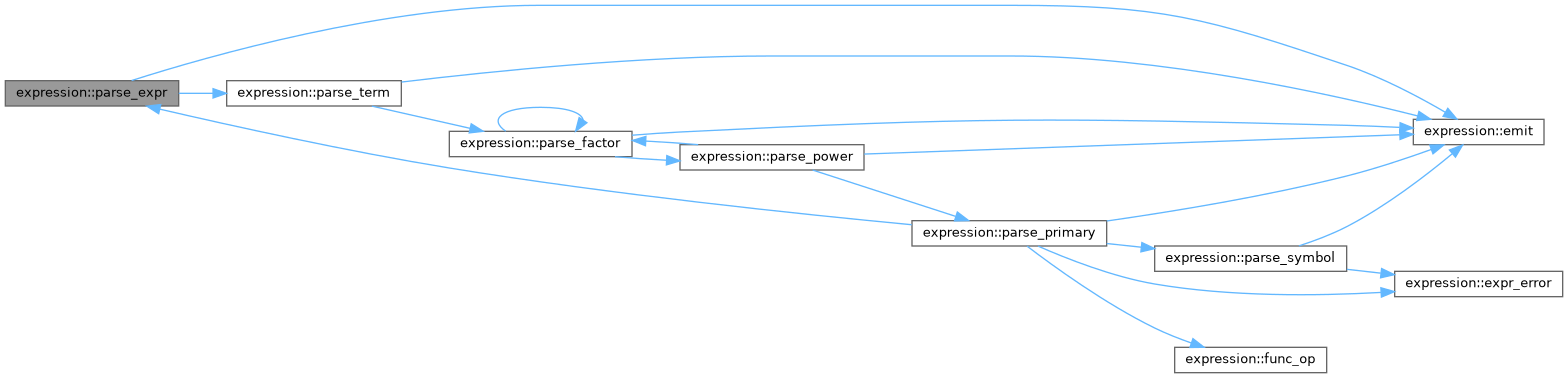
| recursive subroutine | parse_expr (p) |
| Parse an additive expression. | |
| recursive subroutine | parse_term (p) |
| Parse a multiplicative expression. | |
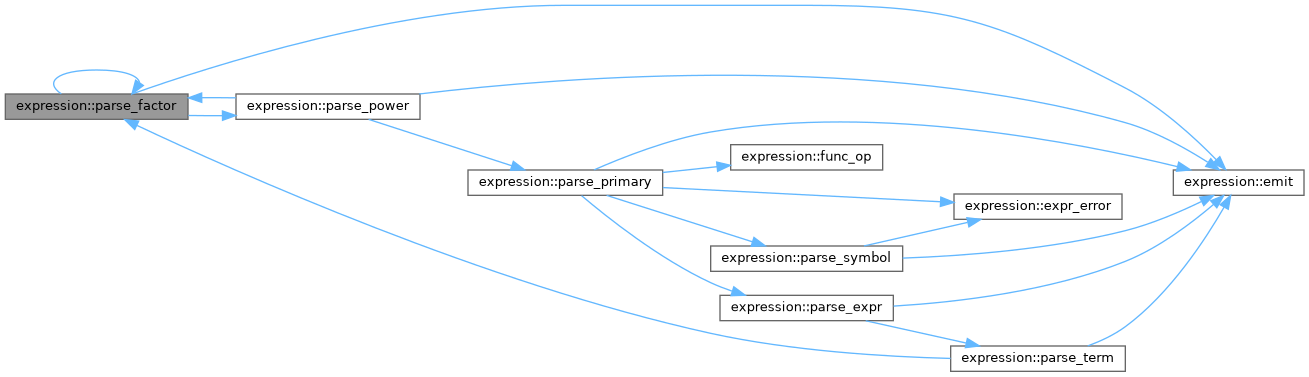
| recursive subroutine | parse_factor (p) |
Parse a possibly signed factor. Unary minus binds looser than ^, so -x^2 is -(x^2), as in Fortran. | |
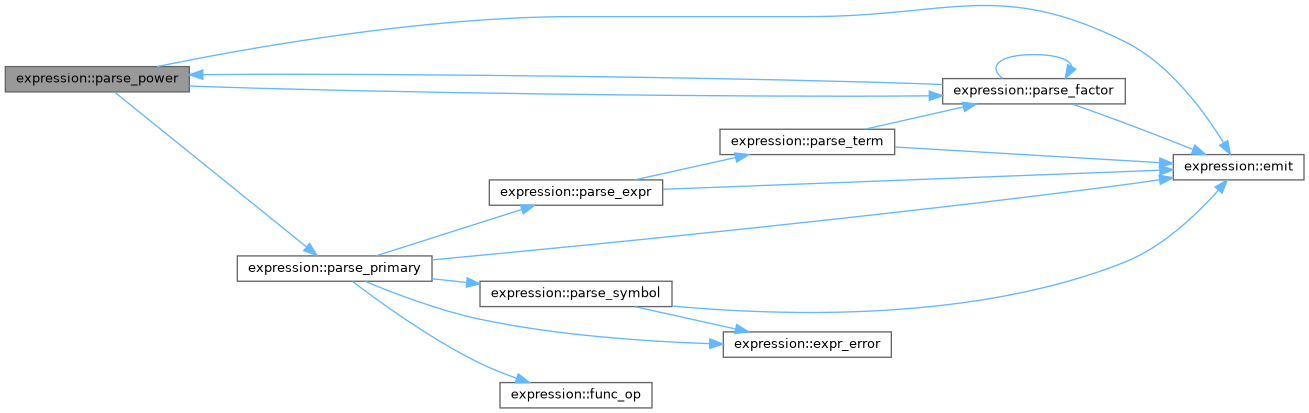
| recursive subroutine | parse_power (p) |
Parse an exponentiation. Right associative, so 2^3^2 is 2^(3^2). | |
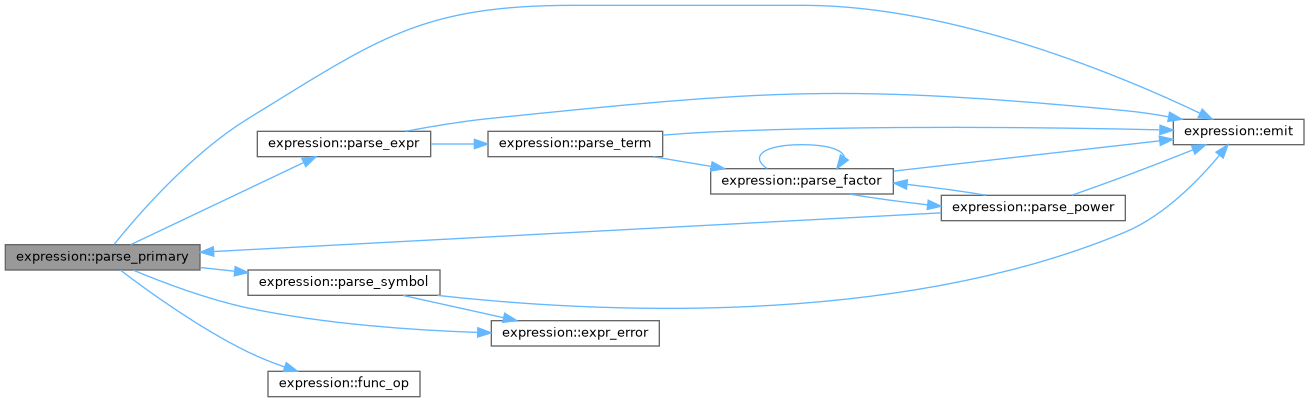
| recursive subroutine | parse_primary (p) |
| Parse a literal, a symbol, a function call or a parenthesised expression. | |
| subroutine | parse_symbol (p, k) |
| Resolve a bare identifier into either a variable opcode or a literal. | |
| integer function | func_op (name, nargs) |
| Look up the opcode of a function. | |
| subroutine | emit (p, op, val) |
| Append an opcode, keeping track of how deep the evaluation stack gets. | |
| subroutine | expr_error (p, msg, pos) |
| Abort with a message pointing at the offending part of the expression. | |
| pure logical function | is_digit (c) |
True if c is a decimal digit. | |
| pure logical function | is_alpha (c) |
True if c is a letter. | |
Detailed Description
An expression_t is compiled once, from a string such as "6*U_b*y*(H - y)/H^2", into a stream of stack machine opcodes. It can then be evaluated over an arbitrary set of points, with x, y and z bound to the point coordinates and t, dt bound to the time state.
Any identifier which is not a coordinate, a time variable or the constant pi is looked up in the neko_const_registry when the expression is compiled, and folded into a literal. This is the same mechanism as the one used by json_get_or_lookup, so constants declared under case.constants in the case file can be used directly in the expressions.
Function/Subroutine Documentation
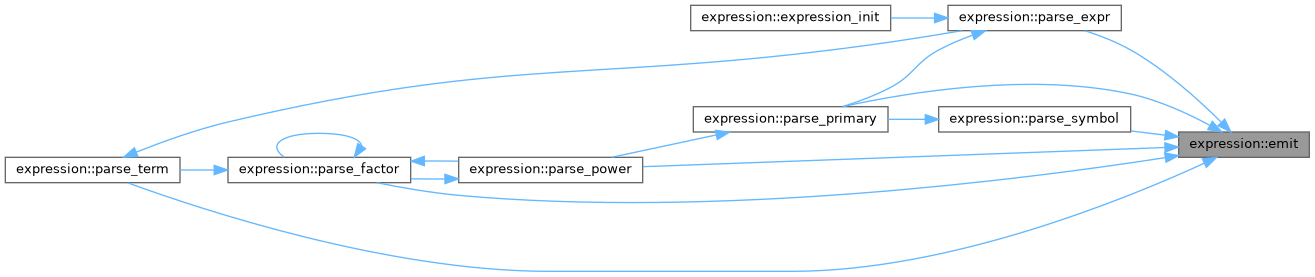
◆ emit()
|
private |
- Parameters
-
[in,out] p The parser state. [in] op The opcode to append. [in] val The literal operand, only meaningful for OP_LIT.
Definition at line 943 of file expression.f90.
◆ expr_error()
|
private |
- Parameters
-
[in] p The parser state. [in] msg What is wrong with the expression. [in] pos Position in the source string to point at.
Definition at line 973 of file expression.f90.

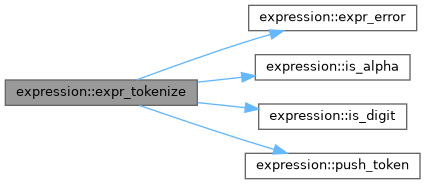
◆ expr_tokenize()
|
private |
- Parameters
-
[in,out] p The parser state, whose srcholds the expression.
Definition at line 514 of file expression.f90.

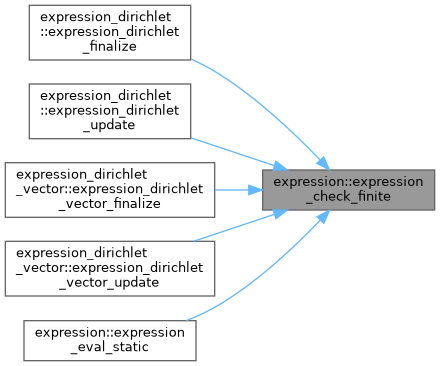
◆ expression_check_finite()
| subroutine, public expression::expression_check_finite | ( | character(len=*), intent(in) | str, |
| real(kind=rp), dimension(n), intent(in) | res, | ||
| integer, intent(in) | n, | ||
| character(len=*), intent(in) | usage | ||
| ) |
Split out of expression_eval_static so that the boundary conditions, which compile and evaluate their expressions themselves, can apply the same check. A non-finite value typically means a division by zero or the square root of a negative number somewhere.
- Parameters
-
[in] str The expression, used in the error message. [in] res The values to check. [in] n The number of values. [in] usage What the expression configures, used in error messages.
Definition at line 492 of file expression.f90.

◆ expression_eval()
|
private |
Not thread safe. The evaluation stack is a component of the expression, so two concurrent calls on the same object corrupt each other's intermediate values. A caller inside an OpenMP parallel region must evaluate on one thread only.
- Parameters
-
[in,out] res The result, one value per point. [in] n The number of points. [in] x The x-coordinates of the points. [in] y The y-coordinates of the points. [in] z The z-coordinates of the points. [in] t The current time, required if the expression uses t.[in] dt The current timestep, required if the expression uses dt.
Definition at line 226 of file expression.f90.
◆ expression_eval_static()
| subroutine, public expression::expression_eval_static | ( | character(len=*), intent(in) | str, |
| real(kind=rp), dimension(n), intent(inout) | res, | ||
| integer, intent(in) | n, | ||
| real(kind=rp), dimension(n), intent(in) | x, | ||
| real(kind=rp), dimension(n), intent(in) | y, | ||
| real(kind=rp), dimension(n), intent(in) | z, | ||
| character(len=*), intent(in) | usage | ||
| ) |
Convenience routine for initial conditions and other setup-time uses of an expression. The expression is rejected if it is empty, if it depends on time, or if it does not evaluate to a finite value in every point, the latter typically meaning a division by zero or the square root of a negative number somewhere in the domain.
- Parameters
-
[in] str The expression. [in,out] res The result, one value per point. [in] n The number of points. [in] x The x-coordinates of the points. [in] y The y-coordinates of the points. [in] z The z-coordinates of the points. [in] usage What the expression configures, used in error messages.
Definition at line 455 of file expression.f90.

◆ expression_free()
|
private |
Definition at line 201 of file expression.f90.
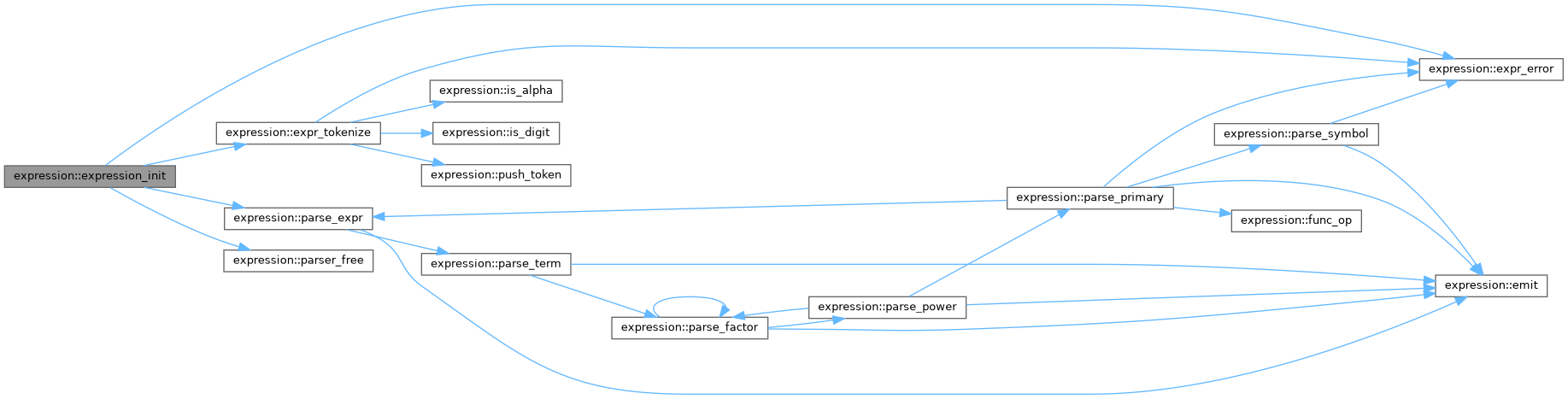
◆ expression_init()
| subroutine expression::expression_init | ( | class(expression_t), intent(inout) | this, |
| character(len=*), intent(in) | str | ||
| ) |
- Parameters
-
[in] str The expression, e.g. "6*U_b*y*(H - y)/H^2".
Definition at line 146 of file expression.f90.
◆ func_op()
|
private |
- Parameters
-
[in] name The name of the function. [in] nargs The number of arguments it was called with.
- Returns
- The opcode, -1 if the name is unknown and -2 if the name is known but the number of arguments is wrong.
Definition at line 877 of file expression.f90.

◆ is_alpha()
- Parameters
-
[in] c The character to test.
Definition at line 997 of file expression.f90.

◆ is_digit()
- Parameters
-
[in] c The character to test.
Definition at line 987 of file expression.f90.

◆ parse_expr()
|
private |
- Parameters
-
[in,out] p The parser state.
Definition at line 665 of file expression.f90.

◆ parse_factor()
|
private |
- Parameters
-
[in,out] p The parser state.
Definition at line 710 of file expression.f90.

◆ parse_power()
|
private |
- Parameters
-
[in,out] p The parser state.
Definition at line 736 of file expression.f90.

◆ parse_primary()
|
private |
- Parameters
-
[in,out] p The parser state.
Definition at line 769 of file expression.f90.

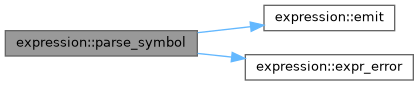
◆ parse_symbol()
|
private |
Coordinates and time variables take precedence over anything else. Everything that is left is looked up in the neko_const_registry and folded into a literal, so the value it had when the expression was compiled is the value that is used.
- Parameters
-
[in,out] p The parser state. [in] k Index of the identifier token to resolve.
Definition at line 830 of file expression.f90.

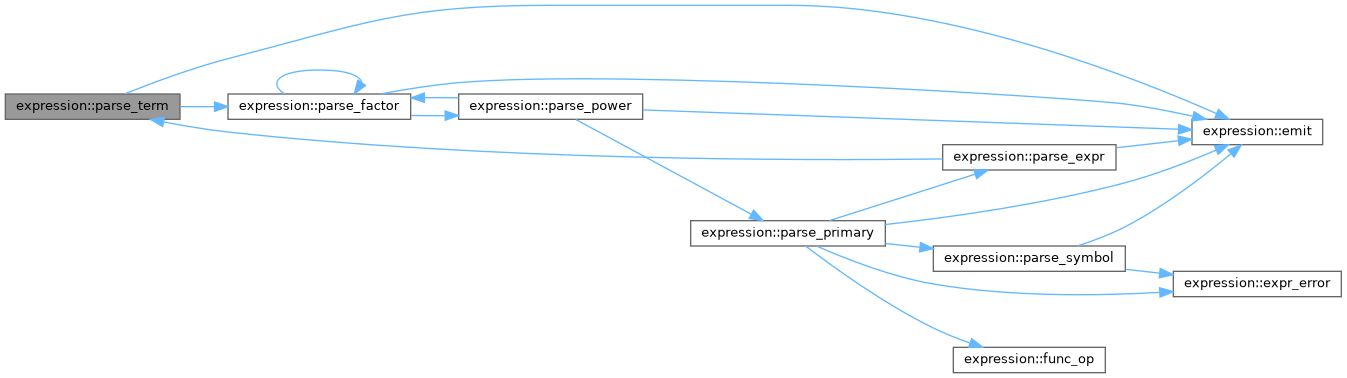
◆ parse_term()
|
private |
- Parameters
-
[in,out] p The parser state.
Definition at line 687 of file expression.f90.

◆ parser_free()
|
private |
- Parameters
-
[in,out] p The parser state.
Definition at line 183 of file expression.f90.

◆ push_token()
|
private |
- Parameters
-
[in,out] p The parser state. [in] kind The kind of the token, one of the TK_constants.[in] pos Position of the token in the source string.
Definition at line 642 of file expression.f90.

Variable Documentation
◆ expr_chunk
Definition at line 63 of file expression.f90.
◆ expr_max_ident
Definition at line 58 of file expression.f90.
◆ neko_expr_len
Definition at line 55 of file expression.f90.
◆ op_abs
Definition at line 74 of file expression.f90.
◆ op_acos
Definition at line 74 of file expression.f90.
◆ op_add
Definition at line 81 of file expression.f90.
◆ op_asin
Definition at line 74 of file expression.f90.
◆ op_atan
Definition at line 74 of file expression.f90.
◆ op_atan2
Definition at line 81 of file expression.f90.
◆ op_binary
Definition at line 80 of file expression.f90.
◆ op_cos
Definition at line 74 of file expression.f90.
◆ op_cosh
Definition at line 74 of file expression.f90.
◆ op_div
Definition at line 81 of file expression.f90.
◆ op_dt
Definition at line 70 of file expression.f90.
◆ op_erf
Definition at line 74 of file expression.f90.
◆ op_erfc
Definition at line 74 of file expression.f90.
◆ op_exp
Definition at line 74 of file expression.f90.
◆ op_ipow
Definition at line 74 of file expression.f90.
◆ op_lit
Definition at line 70 of file expression.f90.
◆ op_log
Definition at line 74 of file expression.f90.
◆ op_log10
Definition at line 74 of file expression.f90.
◆ op_max
Definition at line 81 of file expression.f90.
◆ op_min
Definition at line 81 of file expression.f90.
◆ op_mod
Definition at line 81 of file expression.f90.
◆ op_mul
Definition at line 81 of file expression.f90.
◆ op_neg
Definition at line 74 of file expression.f90.
◆ op_pow
Definition at line 81 of file expression.f90.
◆ op_sin
Definition at line 74 of file expression.f90.
◆ op_sinh
Definition at line 74 of file expression.f90.
◆ op_sqrt
Definition at line 74 of file expression.f90.
◆ op_step
Definition at line 74 of file expression.f90.
◆ op_sub
Definition at line 81 of file expression.f90.
◆ op_t
Definition at line 70 of file expression.f90.
◆ op_tan
Definition at line 74 of file expression.f90.
◆ op_tanh
Definition at line 74 of file expression.f90.
◆ op_unary
Definition at line 73 of file expression.f90.
◆ op_x
Definition at line 70 of file expression.f90.
◆ op_y
Definition at line 70 of file expression.f90.
◆ op_z
Definition at line 70 of file expression.f90.
◆ tk_comma
Definition at line 87 of file expression.f90.
◆ tk_end
Definition at line 87 of file expression.f90.
◆ tk_ident
Definition at line 87 of file expression.f90.
◆ tk_lpar
Definition at line 87 of file expression.f90.
◆ tk_minus
Definition at line 87 of file expression.f90.
◆ tk_num
Definition at line 87 of file expression.f90.
◆ tk_plus
Definition at line 87 of file expression.f90.
◆ tk_pow
Definition at line 87 of file expression.f90.
◆ tk_rpar
Definition at line 87 of file expression.f90.
◆ tk_slash
Definition at line 87 of file expression.f90.
◆ tk_star
Definition at line 87 of file expression.f90.