Gather-scatter.
Data Types | |
| type | gs_t |
| Gather-scatter kernel. More... | |
Functions/Subroutines | |
| subroutine | gs_init (gs, dofmap, bcknd, comm_bcknd) |
| The runtime autotuning of the comm. backend, implemented in the gs_tune submodule: everything the selection needs (the candidate list, the NEKO_GS_TUNE parsing, switching a live gs over to another backend) is private to it, and only what gs_init drives is declared here. | |
| subroutine, public | gs_comm_alloc (comm, comm_bcknd) |
| Allocate a gather-scatter comm. backend of type comm_bcknd. | |
| character(len=12) function, public | gs_comm_name (comm_bcknd) |
| Name of the gather-scatter comm. backend comm_bcknd, right-adjusted for the log. | |
| logical function, public | gs_comm_on_device (comm_bcknd) |
| Whether the comm. backend comm_bcknd exchanges the shared dofs straight out of device memory rather than out of the host mirror of the shared buffer, which is what decides where the gather-scatter backend leaves them (gs_bcknd_tshared_on_host). A host backend on a device build is not device-resident: it drives the exchange from the mirror, at the price of a copy in each direction. | |
| subroutine | gs_free (gs) |
| Deallocate a gather-scatter kernel. | |
| subroutine | gs_vec_alloc (gs) |
| Allocate the buffers the fused vector gather-scatter needs, on the first gs_op_r3 that reaches the fused path. | |
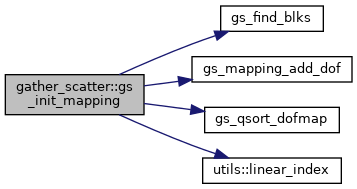
| subroutine | gs_init_mapping (gs) |
| Setup mapping of dofs to gather-scatter operations. | |
| subroutine | gs_schedule (gs) |
| Schedule shared gather-scatter operations. | |
| subroutine | gs_sort_i8 (a, ind, n) |
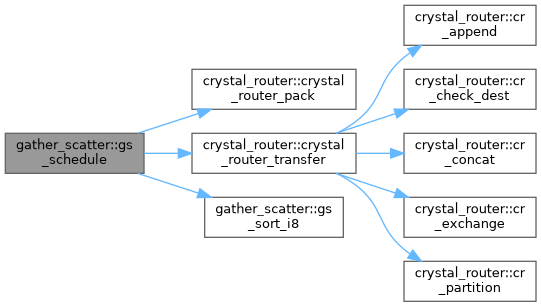
| Heap sort for 64-bit integer arrays, returning the permutation ind. Local helper for gs_schedule (the generic math sort has no i8 variant). | |
| subroutine | gs_op_fld (gs, u, op, event) |
| Gather-scatter operation on a field u with op op. | |
| subroutine | gs_op_r4 (gs, u, n, op, event) |
| Gather-scatter operation on a rank 4 array. | |
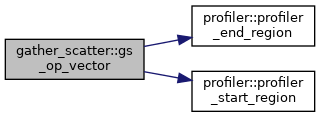
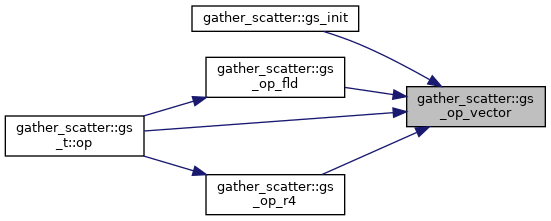
| subroutine | gs_op_vector (gs, u, n, op, event) |
| Gather-scatter operation on a vector u with op op. | |
| subroutine | gs_op_r3 (gs, u1, u2, u3, n, op, event) |
| Gather-scatter operation on a 3-component vector of rank-4 arrays (u1, u2, u3) with op op; see gs_op_vector3. | |
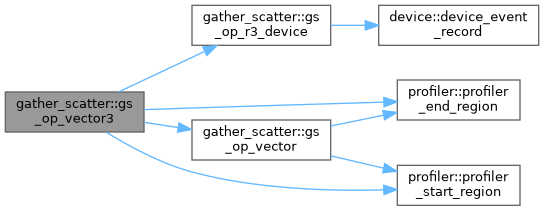
| subroutine | gs_op_vector3 (gs, u1, u2, u3, n, op, event) |
| Gather-scatter operation on a 3-component vector (u1, u2, u3) with op op. When the comm backend supports a fused vector halo exchange, the three components are communicated in a single round; otherwise this falls back to three independent scalar gs_op_vector calls (identical result, 3 rounds). The on-node gather/scatter is always done per component (scalar), so only the communication cost is reduced. On device backends the caller's event is recorded once, after the last component's scatter (or superseded by hard synchronisation on host-mirrored comms), so a single event sync covers all components. | |
| subroutine | gs_op_r3_device (gs, u1, u2, u3, n, op, nc, lo, so, m, l, tid, scatter_event) |
| Device path for the fused 3-component gs. The device backend's shared gather/scatter always operate on its internal shared buffer, so each component is staged between that buffer and its column of the compact vector buffer gsshared_gs_v: through the host mirror when the comm backend is a host backend (shared_on_host, e.g. OpenCL/Metal or a device build with host MPI), or with device-to-device copies when the comm is device-resident (device MPI/NCCL/NVSHMEM). Apart from the column staging the two modes are identical; the comm backends transparently pick the host array or its device pointer, as in gs_op_vector. | |
Variables | |
| integer, parameter | gs_tune_ntrials = 100 |
| Number of timed (and untimed, warm-up) gather-scatter operations per candidate in the runtime autotuning of comm. backends and device synchronisation strategies. | |
| integer, parameter | gs_tune_nwarmup = 2 |
Function/Subroutine Documentation
◆ gs_comm_alloc()
| subroutine, public gather_scatter::gs_comm_alloc | ( | class(gs_comm_t), intent(out), allocatable | comm, |
| integer, intent(in) | comm_bcknd | ||
| ) |
- Parameters
-
comm the allocated backend. Must not hold a live backend on entry: intent(out) releases it without running its free, which would leak whatever resources it holds (symmetric memory, coarrays, uTofu VCQs). Both callers free the previous backend themselves, see gs_free and gs_comm_switch (in the gs_tune submodule). comm_bcknd comm. backend to allocate, one of the GS_COMM_* constants
Definition at line 412 of file gather_scatter.f90.

◆ gs_comm_name()
- Parameters
-
comm_bcknd comm. backend to name, one of the GS_COMM_* constants
Definition at line 448 of file gather_scatter.f90.

◆ gs_comm_on_device()
- Parameters
-
comm_bcknd comm. backend to check, one of the GS_COMM_* constants
- Returns
- whether the backend is device-resident
Definition at line 490 of file gather_scatter.f90.

◆ gs_free()
|
private |
Definition at line 504 of file gather_scatter.f90.
◆ gs_init()
|
private |
Time ntrials gather-scatter operations on u, returning the average wall time (s) per operation on this rank Benchmark the candidate comm. backends and leave gs holding the fastest one Bind the non-blocking synchronisation strategy of the device MPI comm. backend held by gs, benchmarking the strategies unless NEKO_GS_STRTGY names one Initialize a gather-scatter kernel
- Parameters
-
dofmap,global numbering of points and connectivity to base gs on bcknd,backend for executing the gs_ops comm_bcknd,backend for excuting the communication with
Definition at line 187 of file gather_scatter.f90.
◆ gs_init_mapping()
|
private |
- Note
- this might be a bit overkill, but having many collisions makes the init take too long. This is really critical to performance of the init
Definition at line 635 of file gather_scatter.f90.
◆ gs_op_fld()

◆ gs_op_r3()
|
private |

◆ gs_op_r3_device()
|
private |

◆ gs_op_r4()

◆ gs_op_vector()
|
private |
Definition at line 1736 of file gather_scatter.f90.
◆ gs_op_vector3()
|
private |
Definition at line 1833 of file gather_scatter.f90.

◆ gs_schedule()
|
private |
Discovers, for every shared dof, the set of ranks that also hold it, using a canonical-owner rendezvous routed through the crystal router instead of the previous O(P) shifted neighbour exchange. Each dof global id is hashed to an owner rank, mod(gid, P); the owner gathers all holders and reflects, to each holder, the other holders. Each holder then registers the dof for both send and receive with every peer. The per-peer dof lists are ordered by dof global id, which gives the same ordering on both ranks of a pair (the matching invariant the gather-scatter exchange relies on) without ever transmitting a single sequenced key list. Scales to >1e5 ranks without O(P) buffers or unexpected-message buffer exhaustion.
Definition at line 1511 of file gather_scatter.f90.
◆ gs_sort_i8()
|
private |
Definition at line 1651 of file gather_scatter.f90.
◆ gs_vec_alloc()
|
private |
- Parameters
-
gs gather-scatter kernel to complete
- Note
- Rank local, not collective: a rank with no shared dofs never reaches the fused path, so neither this nor comminit_vec may communicate. Backends whose vector buffers come out of an allocation the whole run agrees on make them in init instead, see gs_comm_t.
Definition at line 616 of file gather_scatter.f90.
Variable Documentation
◆ gs_tune_ntrials
Definition at line 146 of file gather_scatter.f90.
◆ gs_tune_nwarmup
Definition at line 147 of file gather_scatter.f90.